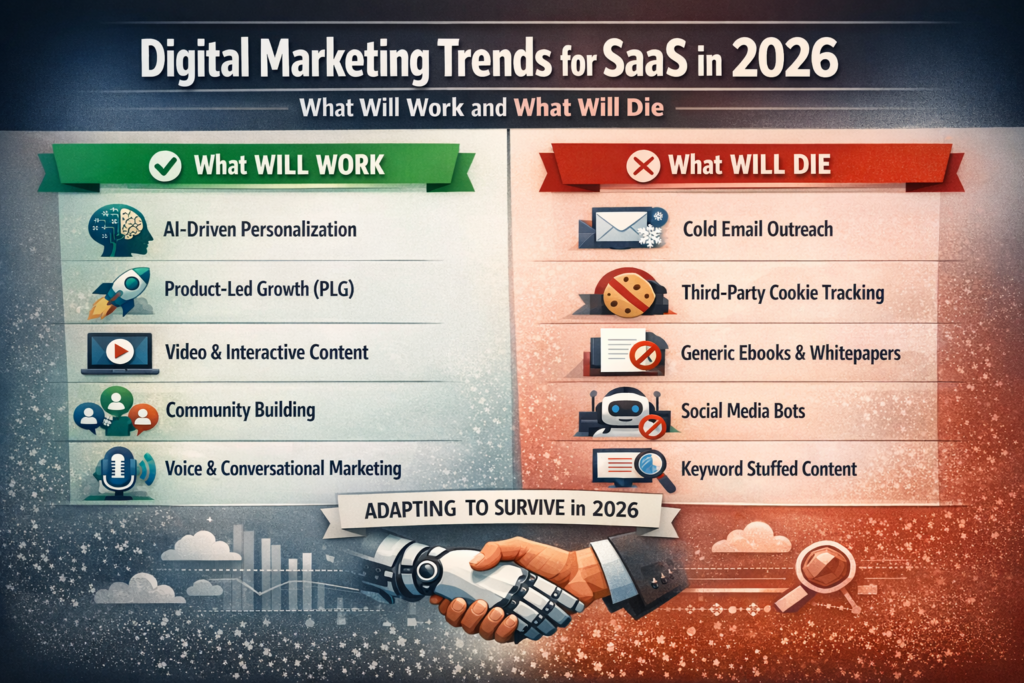
Digital Marketing Trends for SaaS in 2026: What Will Work and What Will Die
Introduction: SaaS Marketing Is Entering Its Most Critical Era
The SaaS landscape has never been more competitive than it is in 2026. With thousands of tools launching every year, customer acquisition is no longer just about visibility—it’s about precision, personalization, and performance.
For companies operating under the Software as a Service model, digital marketing is not just a growth channel—it is the engine of survival. Unlike traditional businesses, SaaS companies rely on recurring revenue, which means success depends on both acquiring and retaining customers efficiently.
But here’s the reality:
What worked in 2022 or even 2024 is quickly becoming outdated.
Algorithms have evolved. Customer expectations have changed. And artificial intelligence is reshaping how marketing works at every level.
This article breaks down:
- The digital marketing strategies that will dominate SaaS in 2026
- The tactics that are becoming obsolete
- How SaaS companies can adapt to stay ahead
Why Digital Marketing Is Critical for SaaS Growth
Before diving into trends, it’s important to understand why SaaS marketing is unique.
1. Recurring Revenue Requires Continuous Engagement
Unlike one-time purchases, SaaS depends on:
- Monthly subscriptions
- Customer retention
- Lifetime value (LTV)
Marketing doesn’t stop after acquisition—it continues throughout the customer journey.
2. High Competition, Low Switching Cost
Customers can switch tools easily. That means:
- Your messaging must be clear
- Your value must be obvious
- Your onboarding must be smooth
3. Data-Driven Decision Making
SaaS companies rely heavily on:
- Analytics
- Conversion tracking
- Funnel optimization
This makes digital marketing both measurable and scalable.
What Will Work in 2026: Winning SaaS Marketing Trends
Let’s explore the strategies that will define success.
1. AI-Driven Marketing Will Become Standard
Artificial intelligence is no longer optional—it is foundational.
AI is transforming:
- Content creation
- Customer segmentation
- Predictive analytics
SaaS companies now use AI to:
- Predict churn
- Personalize emails
- Automate campaigns
Instead of guessing what customers want, businesses can now know in advance.
👉 In 2026, companies that fail to adopt AI will struggle to compete.
2. Hyper-Personalization Will Drive Conversions
Generic marketing is dying.
Customers expect:
- Personalized emails
- Customized landing pages
- Relevant product recommendations
Using behavioral data, SaaS companies can deliver:
- Content based on user activity
- Offers based on needs
- Messaging based on intent
This level of personalization significantly increases:
- Conversion rates
- Customer satisfaction
3. Content Marketing Will Focus on Depth, Not Volume
In the past, publishing more content meant better rankings.
Not anymore.
In 2026:
- Quality beats quantity
- Authority beats frequency
Search engines now prioritize:
- In-depth guides
- Expert insights
- Original research
For SaaS, this means:
- Long-form blog posts
- Case studies
- Industry reports
👉 One powerful article can outperform 50 weak ones.
4. Video Marketing Will Dominate SaaS Communication
Video is becoming the preferred content format.
Why?
- Easier to consume
- More engaging
- Builds trust faster
SaaS companies are using video for:
- Product demos
- Tutorials
- Customer testimonials
Short-form videos (TikTok, Reels, YouTube Shorts) are also driving:
- Brand awareness
- Traffic
- Conversions
5. Product-Led Growth (PLG) Will Expand
Marketing is no longer separate from the product.
Product-led growth means:
- Users experience value before paying
- Free trials or freemium models
- In-app onboarding
Marketing’s role shifts to:
- Driving sign-ups
- Improving user activation
- Supporting product experience
👉 The product becomes the main marketing tool.
6. SEO Will Become More Intent-Focused
Traditional SEO focused on keywords.
In 2026, it focuses on:
- Search intent
- User behavior
- Experience
SaaS companies must create content that:
- Solves real problems
- Matches user intent
- Provides actionable value
Google now rewards:
- Helpful content
- Clear structure
- Expertise
7. Community-Led Growth Will Rise
Communities are becoming powerful marketing channels.
Examples include:
- Slack groups
- Discord communities
- Private forums
Benefits:
- Builds loyalty
- Encourages engagement
- Drives organic growth
Customers trust communities more than ads.
8. First-Party Data Will Replace Third-Party Tracking
Privacy changes are reshaping marketing.
Third-party cookies are disappearing.
SaaS companies must rely on:
- First-party data
- Email lists
- User behavior tracking
This shift requires:
- Better data collection strategies
- Stronger customer relationships
9. Influencer Marketing Will Become B2B-Focused
Influencer marketing is no longer just for B2C.
In SaaS:
- Industry experts
- LinkedIn creators
- Niche influencers
These individuals drive:
- Trust
- Authority
- Conversions
Micro-influencers often outperform big names.
10. Automation Will Scale Everything
Automation tools are enabling:
- Email sequences
- Lead nurturing
- Customer onboarding
This reduces manual work and increases efficiency.
In 2026, automation is not a luxury—it’s a necessity.
What Will Die in 2026: Outdated SaaS Marketing Strategies
Now let’s talk about what’s fading away.
1. Generic Mass Email Campaigns
Sending the same email to everyone no longer works.
Problems:
- Low open rates
- Low engagement
- High unsubscribe rates
👉 Personalization is replacing mass messaging.
2. Keyword Stuffing SEO
Old SEO tactics like:
- Overusing keywords
- Writing for bots
Are now penalized.
Search engines prioritize:
- Natural writing
- User value
3. Over-Reliance on Paid Ads
Paid ads are becoming:
- More expensive
- Less effective
SaaS companies relying only on ads will struggle.
👉 Organic growth is becoming essential.
4. Long Sales Funnels
Customers want:
- Faster decisions
- Immediate value
Complex funnels with too many steps reduce conversions.
5. Ignoring Customer Experience
Bad onboarding, poor UX, and slow support will:
- Increase churn
- Damage reputation
Customer experience is now part of marketing.
6. One-Size-Fits-All Content
Different audiences need different messages.
Generic content fails to connect.
7. Static Websites
Websites must be:
- Dynamic
- Personalized
- Interactive
Static pages are no longer effective.
8. Vanity Metrics Focus
Metrics like:
- Page views
- Likes
Are less important than:
- Conversions
- Retention
- Revenue
How SaaS Companies Should Adapt in 2026
To stay competitive, SaaS businesses must evolve.
1. Invest in AI Tools
Use AI for:
- Content
- Analytics
- Automation
2. Focus on Customer Journey
Map every stage:
- Awareness
- Consideration
- Conversion
- Retention
3. Build Authority Content
Create:
- Guides
- Reports
- Case studies
4. Optimize for Retention
Retention is more profitable than acquisition.
5. Build a Strong Brand
Brand trust drives long-term success.
Real-World SaaS Marketing Example (Simplified)
A SaaS company that:
- Uses AI for personalization
- Offers a free trial
- Creates helpful content
Will outperform a company that:
- Uses generic ads
- Has no onboarding
- Lacks content strategy
The Future of SaaS Marketing
Looking ahead, SaaS marketing will become:
- More intelligent
- More automated
- More personalized
Companies will rely on:
- AI agents
- Predictive analytics
- Real-time data
Conclusion: Adapt or Fall Behind
Digital marketing for SaaS in 2026 is not about doing more—it’s about doing smarter.
The companies that win will:
- Embrace AI
- Focus on customer experience
- Invest in quality content
- Build strong relationships
And those that don’t?
They will slowly disappear in an increasingly competitive market.