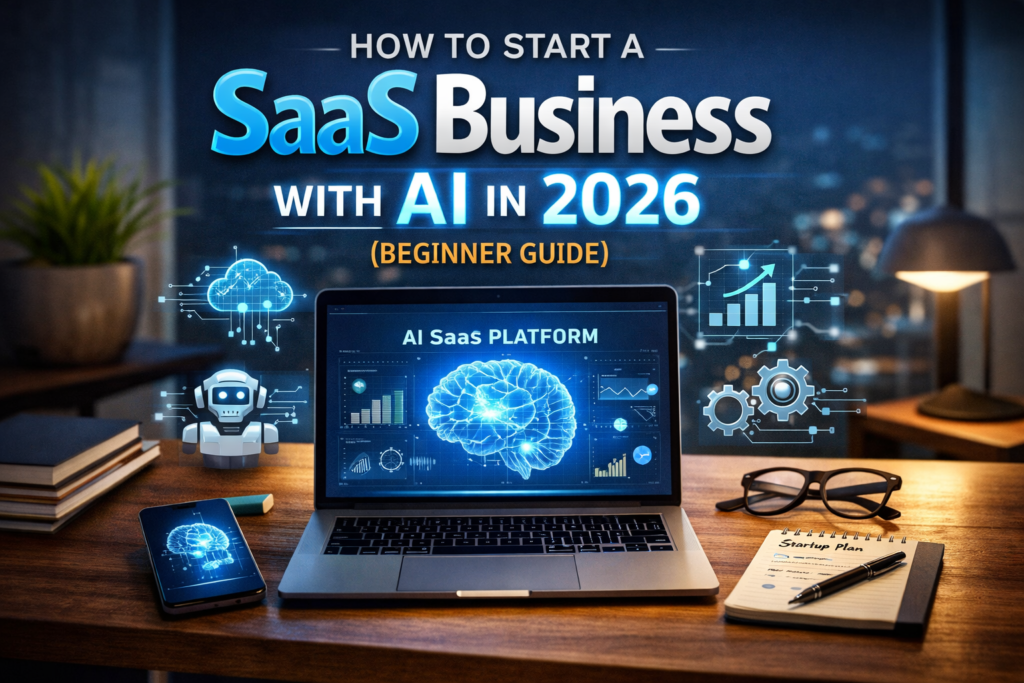
How to Start a SaaS Business with AI in 2026 (Beginner Guide)
Introduction: Why 2026 Is the Best Time to Start a SaaS Business
There has never been a better time to start a SaaS business than now. The rise of artificial intelligence has fundamentally changed how software is built, launched, and scaled. What once required a full development team, months of coding, and significant capital can now be achieved by a small team—or even a solo founder—with the right tools and strategy.
At the center of this transformation is Software as a Service, a model that allows businesses to deliver software over the internet with recurring revenue. Combined with the power of Artificial Intelligence, SaaS has become one of the most profitable and scalable business models in the digital economy.
This guide is designed for beginners who want to build a SaaS business using AI in 2026. Whether you have technical experience or not, this step-by-step approach will help you understand how to go from idea to launch—and beyond.
What Is a SaaS Business?
A SaaS business delivers software applications through the cloud instead of requiring users to install them locally. Customers typically pay a subscription fee—monthly or annually—to access the product.
Key Characteristics of SaaS:
- Cloud-based access
- Subscription pricing
- Continuous updates
- Scalable infrastructure
Examples of SaaS products include:
- Project management tools
- Marketing platforms
- Accounting software
The beauty of SaaS lies in its predictability. Once you acquire customers, you generate recurring revenue, making it easier to forecast growth and reinvest in your business.
How AI Is Changing SaaS in 2026
Artificial intelligence is no longer just a feature—it is becoming the core of modern SaaS products.
AI Enables:
- Faster product development
- Smarter user experiences
- Automated workflows
- Data-driven decision making
In 2026, many successful SaaS products are:
- AI-powered from the start
- Built with automation in mind
- Designed to solve specific problems efficiently
This shift lowers the barrier to entry, making it easier for beginners to build competitive products.
Step 1: Identify a Profitable SaaS Idea
Every successful SaaS business starts with a clear problem.
Focus on Problems, Not Ideas
Instead of asking “What should I build?” ask:
- What problems do people face daily?
- What tasks are repetitive or time-consuming?
- Where can AI provide value?
Popular SaaS Niches in 2026:
- Marketing automation
- Customer support
- Content creation
- Finance and accounting
- E-commerce tools
Pro Tip:
Look for problems in industries you understand. This gives you an advantage when designing your solution.
Step 2: Validate Your Idea Before Building
One of the biggest mistakes beginners make is building a product without validation.
How to Validate:
- Talk to potential users
- Post in online communities
- Create a simple landing page
- Collect email sign-ups
If people are willing to:
- Sign up
- Show interest
- Pay (even small amounts)
👉 You have a valid idea.
Step 3: Define Your Target Audience
Not everyone is your customer.
Identify:
- Who needs your product?
- What industry are they in?
- What is their biggest pain point?
Example:
Instead of targeting “business owners,” narrow it down to:
👉 “Small e-commerce store owners struggling with customer support”
The more specific your audience, the easier it is to market your product.
Step 4: Choose the Right AI Tools
You don’t need to build AI from scratch.
Modern tools allow you to:
- Integrate AI features
- Automate processes
- Build faster
What to Look For:
- Ease of use
- Integration capabilities
- Scalability
AI tools can help with:
- Chatbots
- Content generation
- Data analysis
Step 5: Build a Minimum Viable Product (MVP)
Your goal is not to build a perfect product—it’s to build a usable one.
MVP Focus:
- Core functionality
- Solving one main problem
- Simple user interface
Avoid:
- Too many features
- Overcomplication
- Long development cycles
Launch fast, then improve based on feedback.
Step 6: Choose a Business Model
Most SaaS businesses use subscription pricing.
Common Pricing Models:
- Monthly subscription
- Annual subscription
- Freemium model
- Pay-as-you-go
Tips:
- Keep pricing simple
- Offer a free trial
- Provide clear value
Step 7: Build Your Brand and Website
Your website is your main sales tool.
Must-Have Elements:
- Clear headline
- Value proposition
- Product demo
- Pricing page
- Call-to-action
Your messaging should answer:
👉 “Why should I use this product?”
Step 8: Launch Your SaaS Product
Don’t wait for perfection.
Launch Strategies:
- Beta launch
- Early access
- Limited release
Where to Promote:
- Social media
- Online communities
- Product launch platforms
Focus on getting your first users.
Step 9: Acquire Your First Customers
Customer acquisition is the hardest part.
Effective Strategies:
- Content marketing
- SEO
- Email marketing
- Social media
Key Tip:
Focus on one or two channels first—don’t try everything at once.
Step 10: Optimize and Scale
Once you have users, your focus shifts to growth.
Improve:
- User experience
- Onboarding process
- Customer support
Track:
- Conversion rates
- Retention rates
- Customer feedback
Scaling comes from continuous improvement.
Common Mistakes to Avoid
1. Building Without Validation
2. Adding Too Many Features
3. Ignoring Customer Feedback
4. Weak Marketing Strategy
5. Poor User Experience
Avoiding these mistakes can save you time and money.
Realistic Timeline to Build a SaaS Business
- Week 1–2: Idea validation
- Week 3–6: MVP development
- Week 7: Launch
- Month 3+: Growth and scaling
The Future of AI-Powered SaaS
Looking ahead, SaaS will become:
- More automated
- More intelligent
- More personalized
AI will handle:
- Customer interactions
- Data analysis
- Decision-making
Businesses that embrace this shift will have a significant advantage.
Conclusion: Start Now, Learn Fast
Starting a SaaS business with AI in 2026 is more accessible than ever. You don’t need to be an expert developer or have a large budget.
What you need is:
- A clear problem
- A simple solution
- A willingness to learn
The most important step is to start.
Because in the world of SaaS:
👉 Speed matters more than perfection.